
Project Reports
Reports by members of the Performance Research Group
Members of the Performance Research Group are involved in public facing work with deep impact on policy and society more widely. Here are some of the reports that they have contributed to over the last five years. Please find our annual report here for the academic year 2024/25 that shows a range of our members’ work.
PRG Annual Report 2024/25

British Ritual Innovation under COVID-19 (BRIC-19)
Understanding how Britain’s religious communities adapted during — and responded to — the COVID-19 pandemic.
BRIC-19 (2020)
The project Social Distance, Digital Congregation: British Ritual Innovation under COVID-19 (BRIC-19) captured and analysed how the pandemic impacted the ways that religious communities across Britain came together for ritual worship. To understand the consequences of these changes, the project looked at the ways religious communities are organised and controlled.
Before the pandemic, in-person worship was an essential part of most religious communities. Regular rituals and holidays built a sense of connection, and gave members comfort, hope, resilience and stability.
Lockdown restrictions meant these rituals were no longer possible. What were the clergy to do? In a way, they became performance artists — forced to make do with the tools around them in order to serve the needs of the religious public.
Freelancers in the Dark: The Economic, Cultural, and Social Impact of Covid-19 on UK Theatre Workers Final Report (2023)
Freelancers in the Dark (2023)
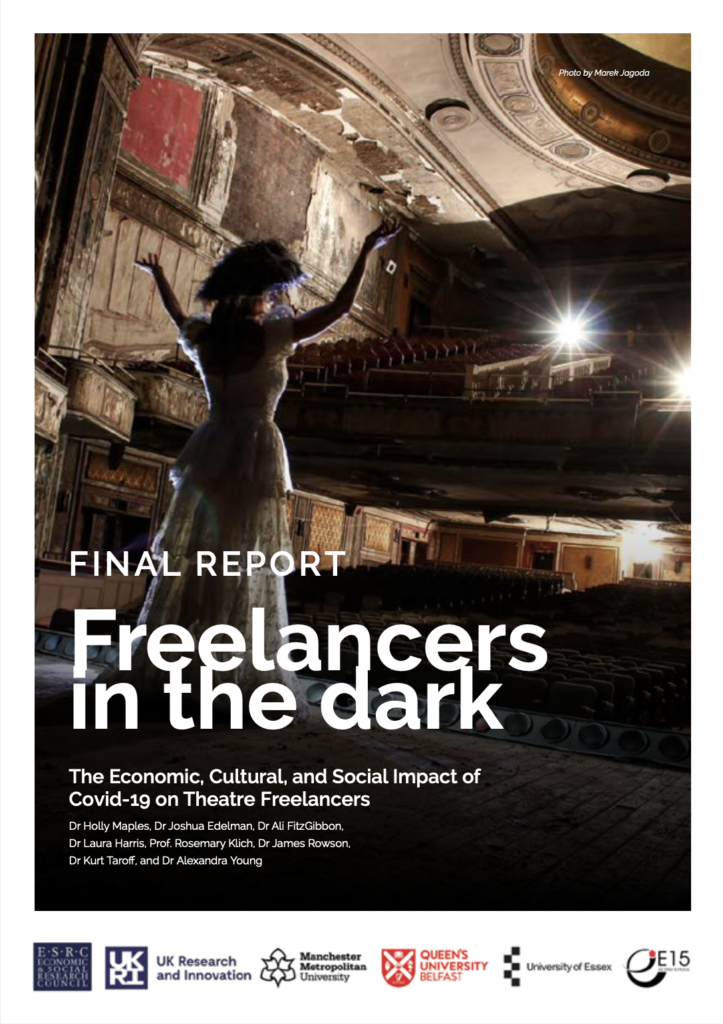
This report captures an extraordinary moment in time for the UK theatre industry. However, as we discovered, it also reveals the pre-existing issues found within the industry that left the UK theatre sector vulnerable to devastating consequences for theatre workers lives and livelihoods during Covid-19. As we have shown, those consequences greatly impacted all areas of the UK theatre industry and its freelance theatre workforce.
When this project was conceived in the Spring of 2020, we had no idea that by March 2022, we would still be suffering sector uncertainty caused by wave after wave of Covid-19 variants. This report is an archive of sorts, mapping out the evolution of UK freelance theatre workers’ experiences over a 2-year period beginning in February 2020. Experiences of volatility, struggle, opportunity, resilience, community, activism, and creativity are all to be found in the lived realities of the freelance theatre workforce documented in these pages.
In the end, this is not solely a research study, but a co-created testament of how the pandemic shone a light on the hopes and fears of the theatre workforce (both freelance and organisations) at a moment in time where radical change was seen as possible in the midst of, arguably, the most long-term crisis to hit the UK theatre industry since the English Civil War in the 17th century. Through the honesty and generosity of our research participants, we were able to offer a reflection and analysis of all that makes the UK theatre industry to me, and the freelancers who occupy 88% of its workforce, endless sources of resilience, creative thinking, and collective support.
Community Research Ethics Initiative
CREI (2026)
Duration of project
Duration of the project: February 2025 – March 2026.
CHANSE projects and partners leading and/or collaborating on the initiative
• Recovira: Joshua Edelman
• DigitIslam: Avi Astor, Katarzyna Górak-Sosnowska
• DiDe: Johanna Sumiala
Initiative summary
Current research ethics protocols across Europe struggle to deal with human participants, especially with respect to digital methods. Although protecting human participants is of the utmost importance, poorly designed or implemented ethics protocols may erode trust and generate needless obstacles to the research process. Moreover,
the imbalances in ethical protocols across Europe impede necessary comparative research and frustrate both researchers and research subjects. This not only generates inefficiencies in the use of academic resources; it leads to a lack of appropriately comparative research that can address important issues of contemporary digital societies.
We will use our expertise and experience to develop a common ethical framework for research involving human participants, digital research, and/or sensitive issues that can be implemented by universities, funding bodies, and the like. We will develop this framework through a survey and focus groups of research subjects from our CHANSE projects. We will finalise it at the final CHANSE conference with the KEF’s team’s assistance, and test it out through two workshops and a final set of focus groups.
Audiences
• Members of the public who volunteer to be research subjects (via surveys, interviews, etc)
• Research policy-makers, including governments and foundations, across Europe
• Academic colleagues who lead or participate in an ethics process
If you are interested in engaging with the research, or if you have suggestions for improving ethics protocols around Europe, we’d love to hear from you. Please email the team at crei@mmu.ac.uk.
Granny Jackson’s Dead (2023)
Granny Jackson’s Dead is a pioneering interdisciplinary project that demonstrates how immersive theatre can function as a rigorous, ethical, and impactful method for public deliberation on emerging technologies. Developed by Big Telly Theatre Company in collaboration with researchers from Manchester Metropolitan University and qualitative researcher Eleanor O’Keeffe, the project combines immersive performance, creative technologies, and social research to explore public attitudes towards ‘grief tech’ – digital tools that mediate memory, mourning, and memorialisation.
At a moment when AI-enabled grief technologies are rapidly proliferating, yet remain under-regulated and poorly understood in public and policy discourse, Granny Jackson’s Dead offers a timely and necessary intervention. Rather than approaching grief tech through abstract debate or attitudinal surveys, the project situates audiences within a familiar yet emotionally charged social ritual – the wake – allowing them to think, feel, and deliberate collectively about the ethical, cultural, and social implications of these technologies.
Central to the project is the methodological innovation of embedded dramaturgy, in which researchers were integrated into the creative process from development through performance. This approach enabled immersive theatre to operate not simply as a vehicle for representation, but as a live research instrument capable of generating rich, situated evidence about public values, concerns, and expectations. The integration of AI, VR, motion capture, and audience interaction – developed with the School of Digital Arts (SODA) – further extended the project’s capacity to probe how digital technologies reshape experiences of presence, loss, and care. Across a national and international tour, including the UK, Ireland, and the United States, the production engaged broad audiences and generated substantial qualitative data through observation, post-show dialogue, and survey responses.
Findings reveal widespread ambivalence towards grief tech: while some participants recognised potential therapeutic benefits, particularly in maintaining bonds with the deceased, many expressed deep concern about commercialisation, loss of communal ritual, ethical oversight, and the erosion of collective care practices. Notably, audiences consistently framed grief tech as a social and communal issue, rather than a purely personal or consumer choice.
Beyond its research findings, Granny Jackson’s Dead demonstrates the cultural value of arts-led dialogue as a means of fostering informed public conversation on complex and sensitive issues. The project encourages us to see the productive synergies between the audiences in immersive theatre and the temporary ‘mini-publics’ of deliberative events, in which participants engage thoughtfully, emotionally, and ethically with technological change – in this case, often continuing conversations long after the performance ends. As such, it provides a compelling model for how the arts can contribute meaningfully to policy development, ethical technology governance, and public understanding.
Researchers: Joshua Edelman, Kirsty Fairclough, Eleanor O’Keeffe, Michael Pinchbeck and Alasdair Swenson.